Academic Staff
Jonas Hummel

Profile
Since starting my PhD in August 2024, my research has centered on earable technologies, particularly OpenEarable 2.0, and their potential as multimodal platforms for sensing and interaction. With a background in Psychology (B.Sc.) and Social and Economic Data Science (M.Sc.), and as a member of the KD2-School, I investigate applications at the intersection of human-computer interaction, digital health, and biosignal-adaptive systems.
My work began with EarXplore, an interactive research database for systematically exploring and structuring the growing field of earable interaction research. I further develop and evaluate concrete earable applications, including CHOMP, a multimodal system for chewing-side detection, and NeuroClick, which explores tooth-click input as a hands-free interaction technique for neurosurgical workflows. More broadly, I am interested in how earables can evolve beyond audio devices into intelligent platforms for continuous sensing, interaction, and adaptive support.
Short CV
- since 2024: PhD Candidate at TECO and Member of the Kd2 Graduate-School
- 2021 – 2024: M.Sc. Social and Economic Data Sience at University of Konstanz
- 2017 – 2021: B.Sc. Psychology at Philipps-University Marburg
Research Interests
- Human-Computer-Interaction (with Earables)
- Data Science
- HealthTech
- Biosignal-Adaptive Systems
- Interdisciplinary Topics between Data Science and Psychology or Economics
Teaching
- Praktikum: Wearable Computing (WS)
- (Pro)Seminar: Biosignal-Adaptive Systems (SS)
- Statistics @ Praxis der Forschung (WS/SS)
Projects

EarStreAM
EarStreAM is a closed-loop earable system that detects stress through in-ear sensing and automatically delivers personalized, LLM-generated meditation, adapting the intervention until the user’s physiological state returns toward baseline.
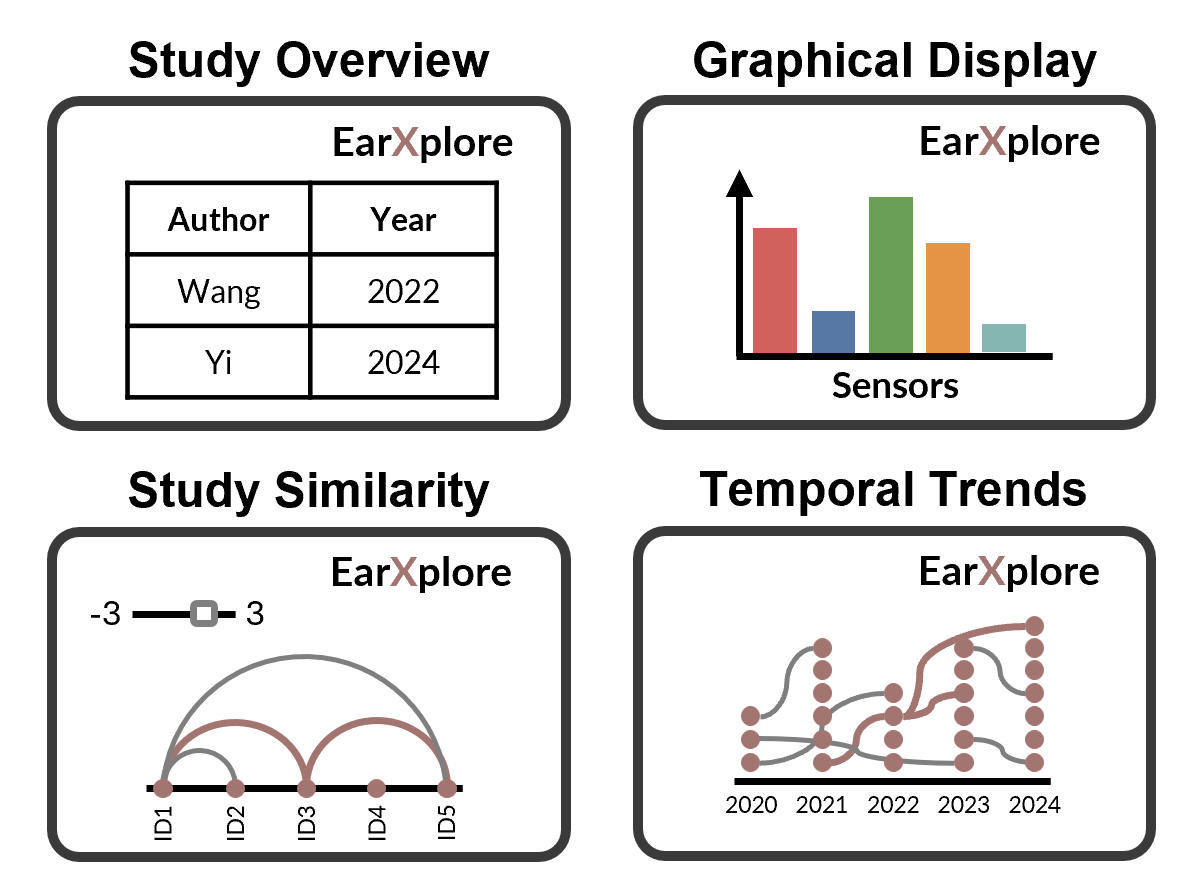
EarXplore
EarXplore is an evolving, interactive database that organizes and visualizes research on earables. It helps the community explore existing studies, uncover trends, and shape the future of earable technology.

KD²School
An interdisciplinary graduate school focused on designing adaptive IT systems that improve economic decision-making. The research explores the intersection of human behavior, technology, and institutions.
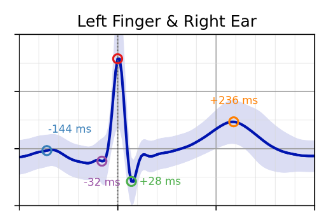
Finger-to-Ear ECG
Finger-to-Ear ECG explores earbud-based cardiac monitoring by combining an in-ear electrode with finger contact, enabling high-quality ECG recordings and morphology preservation in a practical wearable form factor.
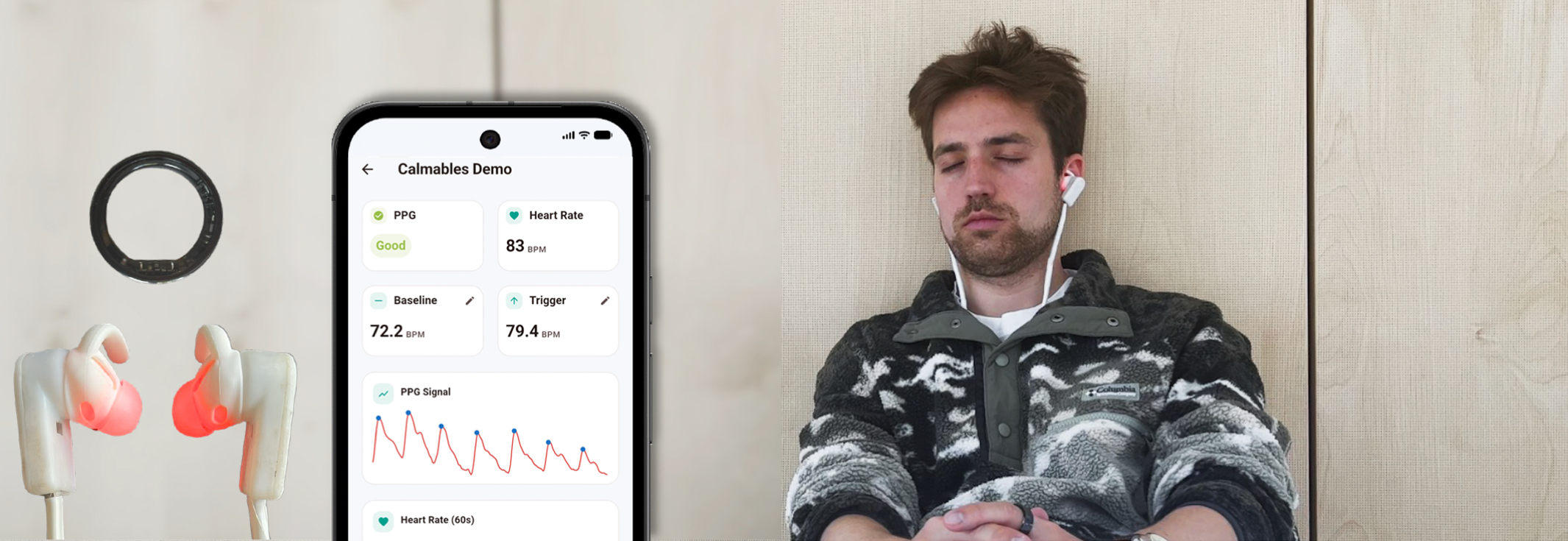
Calmables
Calmables is a closed-loop infrared earable designed to explore thermal biofeedback for relaxation support. The system uses heart-rate data from a smart ring to establish an individual baseline and identify periods of elevated physiological activation. When a personalized threshold is reached, the earable delivers a subtle, localized warming stimulus to the ear using infrared light. A companion smartphone application coordinates the interaction and visualizes physiological changes, while independent temperature limits and communication fail-safes ensure safe operation. In a preliminary placebo-controlled evaluation with 18 participants, the active prototype received higher ratings for perceived relaxation and recovery support than an identical-looking placebo device. Calmables demonstrates how physiological sensing and unobtrusive thermal stimulation can be combined to make biofeedback tangible and support brief moments of recovery.
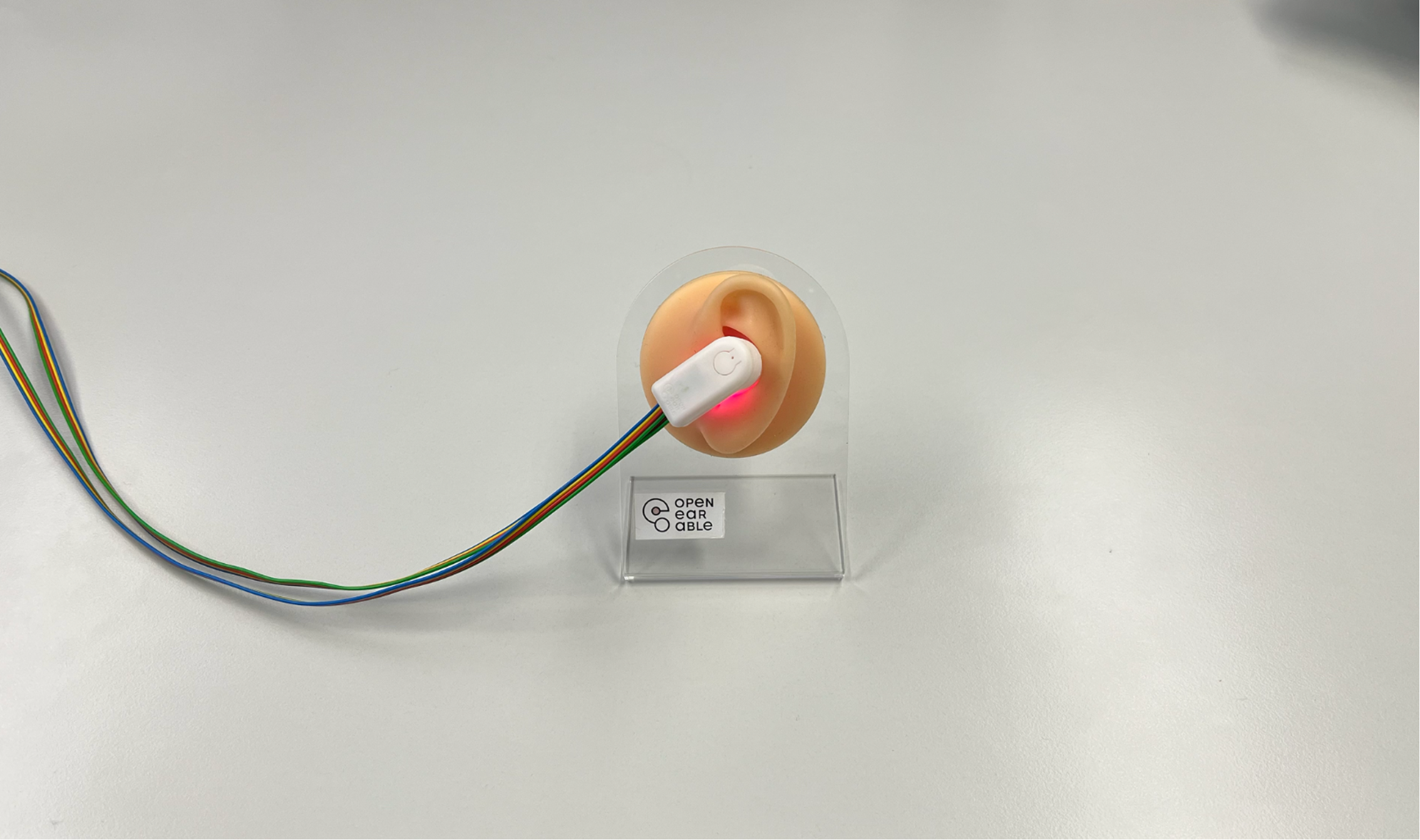
Heatables
Heatables investigates the use of near-infrared (NIR) and infrared (IR) optical stimulation within the human ear to modulate thermal perception and comfort. The project explores the auditory canal as a novel physiological and perceptual interface for personalized thermal regulation.

OpenEarable
OpenEarable is an open-source, AI-enabled platform for ear-based sensing applications with true wireless audio. The modular and reconfigurable platform is packed with a variety of high-precision sensors, designed for both development and research applications.
Theses
No open theses.
Topic Areas
Publications
Bennardo, L. L.; Weber, L.; Hummel, J.; Feick, M.
2026. CHI EA ’26: Proceedings of the Extended Abstracts of the 2026 CHI Conference on Human Factors in Computing Systems. Ed.: N. Oliver, 1–6, Association for Computing Machinery (ACM). doi:10.1145/3772363.3798694
Lepold, P.; Breitling, P.; Hummel, J.; Röddiger, T.; Beigl, M.
2026. ISWC ’26: Proceedings of the 2026 ACM International Symposium on Wearable Computers, 71–77, Association for Computing Machinery (ACM). doi:10.1145/3830727.3834819
Zitz, V.; Küttner, M.; Hummel, J.; Knierim, M. T.; Beigl, M.; Röddiger, T.
2025. Proceedings of the ACM International Symposium on Wearable Computers (ISWC’25), 91–97, Association for Computing Machinery (ACM). doi:10.1145/3715071.3750421
Röddiger, T.; Zitz, V.; Hummel, J.; Küttner, M.; Lepold, P.; King, T.; Paradiso, J. A.; Clarke, C.; Beigl, M.
2025. CHI EA ’25: Proceedings of the Extended Abstracts of the CHI Conference on Human Factors in Computing Systems, Art.-Nr.: 713, Association for Computing Machinery (ACM). doi:10.1145/3706599.3721161