Academic Staff
Supraja Ramesh
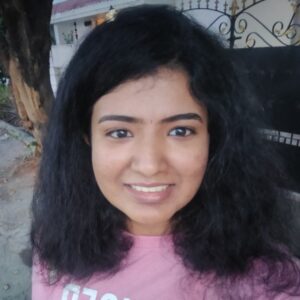
Profile
I am a PhD student working on earable technology for health applications, with a focus on biosignal processing and machine learning methods for robust, real-world health monitoring. Feel free to contact me if you’re looking for thesis topics in earables, machine learning, or biosignal analysis.
Short CV
- since 2024 PhD Candidate at TECO
- 2022 – 2024 M.Sc. Medical Technology at Friedrich-Alexander-University Erlangen-Nuremberg
- 2018 – 2022 (Senior) Software Engineer at Freshworks (India)
- 2014 – 2018 B.Tech. Electrical & Electronics Engineering at SASTRA Deemed University (India)
Research Interests
- Biosignals
- Deep Learning
- Wearables
Teaching
Proseminar: Mobile Computing (WS/SS)
Proseminar: Designing and Conducting Experimental Studies (WS/SS)
Theses
No open theses.
Topic Areas
Biosignal Analysis and TechnologiesData Mining
Publications
2026
Reassessing the Feasibility of PPG-Based Non-Invasive Blood Glucose Level Estimation
Ramesh, S.; Neufeld, M.; Küttner, M.; Röddiger, T.; Beigl, M.
2026. ISWC ’26: Proceedings of the 2026 ACM International Symposium on Wearable Computers. Ed.: D. Zhang, 127–133, Association for Computing Machinery (ACM). doi:10.1145/3830727.3834821
Ramesh, S.; Neufeld, M.; Küttner, M.; Röddiger, T.; Beigl, M.
2026. ISWC ’26: Proceedings of the 2026 ACM International Symposium on Wearable Computers. Ed.: D. Zhang, 127–133, Association for Computing Machinery (ACM). doi:10.1145/3830727.3834821
2025
Closed-Loop Rhythmic Haptic Biofeedback via Smartwatch for Relaxation and Sleep Onset
Lee, J.; Moschina, D.; Ramesh, S.; Röddiger, T.; Kunze, K.; Beigl, M.
2025. Proceedings of the ACM International Symposium on Wearable Computers (ISWC’25), 30–37, Association for Computing Machinery (ACM). doi:10.1145/3715071.3750412
Lee, J.; Moschina, D.; Ramesh, S.; Röddiger, T.; Kunze, K.; Beigl, M.
2025. Proceedings of the ACM International Symposium on Wearable Computers (ISWC’25), 30–37, Association for Computing Machinery (ACM). doi:10.1145/3715071.3750412